Pokemon Card Conditions Explained
Condition Drives Everything
Two copies of the same card can differ in price by 10x or more based solely on condition. An Umbreon VMAX Alt Art from Evolving Skies sells for $250-350 in near-mint, but a heavily played copy brings $60-90. Understanding condition grading is essential whether you are buying, selling, or insuring your collection.
The Condition Scale
The Pokemon card market uses a standardized condition scale shared across TCGPlayer, eBay listings, and most local card shops. Here is exactly what each level looks like.
Mint (M)
A mint card is indistinguishable from the moment it left the printing press. Perfect corners, flawless surface, dead-center print alignment, no whitening on edges under magnification. In practice, mint cards are rare even fresh from packs because modern printing and packaging introduce minor imperfections.
Mint cards hold full market value and are strong PSA 10 candidates.
Near Mint (NM)
The standard selling condition on TCGPlayer and most online platforms. A near-mint card looks pack-fresh to the naked eye. Under close inspection, you might find one barely visible corner touch, factory print lines, or centering that is slightly off (within 55/45). None of these flaws are noticeable at arm's length.
Price impact: 100% of market value. This is the baseline.
PSA equivalent: 8-10 depending on specific flaws.
Real example: A near-mint Charizard ex SAR from 151 sells for $100-140 on TCGPlayer.
Lightly Played (LP)
The card has seen some handling. You will notice one or more of the following: light whitening on 1-2 corners, a few surface scratches visible when tilting the card under light, minor edge wear along one side, or a small print imperfection. The card still presents well in a binder and looks good from a normal viewing distance.
Price impact: 75-85% of NM value.
PSA equivalent: 5-7 depending on flaw severity.
Real example: That same Charizard ex SAR in LP condition sells for $75-110.
Moderately Played (MP)
Wear is immediately visible without close inspection. Multiple corners show whitening, the surface has scratches you can see without tilting, edges are worn along multiple sides, or there is a light bend that does not crease through the card layers. MP cards are popular among players who want real cards at discount prices and collectors completing sets on a budget.
Price impact: 45-65% of NM value.
PSA equivalent: 3-5.
Real example: Charizard ex SAR in MP sells for $45-80.
Heavily Played (HP)
The card has been through significant use. Deep corner whitening on all four corners, heavy surface scratching, visible creases or folds, edge separation beginning, or moderate water staining. The card is structurally sound (not torn or falling apart) but the wear dominates its appearance.
Price impact: 25-40% of NM value.
PSA equivalent: 1-3.
Real example: Charizard ex SAR in HP sells for $25-50.
Damaged (DMG)
Structural problems beyond normal wear. This includes tears, missing chunks, heavy creases that break through the card layers, tape residue, ink or marker stains, major water damage causing delamination, or significant warping that cannot be flattened. A damaged card is still identifiable but has irreversible issues.
Price impact: 10-20% of NM value for desirable cards. Bulk damaged cards are essentially worthless.
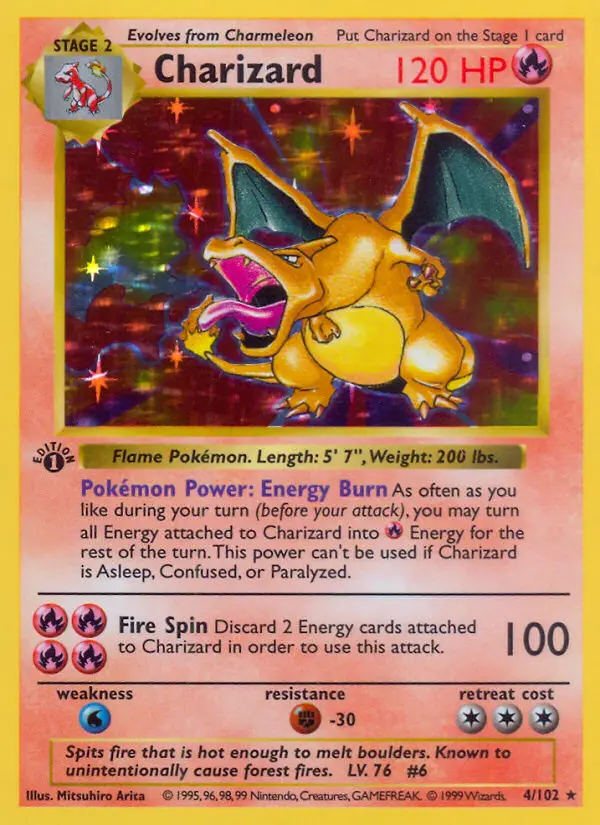
Real example: Charizard ex SAR in damaged condition might sell for $10-25. A damaged Base Set Charizard still sells for $20-40 due to the card's iconic status.
How to Assess Your Own Cards
Follow this checklist in order. Stop at the first condition level where you find matching flaws:
Check corners — Use a loupe or magnifying glass. Any whitening beyond a single microscopic dot moves the card below mint. Whitening on 2+ corners means LP at best.
Check edges — Run your fingertip along all four edges. Feel for any rough spots, nicks, or silvering (exposed card core). Visible edge wear without magnification means MP or below.
Check surface — Hold the card at eye level and slowly tilt it under a bright light. Scratches reflect light differently than surrounding areas. Holo cards show surface damage most readily. Any scratch visible at arm's length is MP territory.
Check for structural damage — Flex the card gently (do not bend it). Feel for any soft spots indicating previous creases. Hold the card flat and sight along the edge to check for bends or warps.
Check centering — Compare the border width on opposite sides. If one side has noticeably more border than the other, centering is off. For reference, 60/40 centering is common and acceptable for NM. Beyond 65/35 starts impacting perceived quality.
Condition Red Flags When Buying Online
- "NM/LP" — This almost always means LP. Sellers hedge with dual grades when they know the card has issues.
- Photos at weird angles — Sellers hiding corner whitening or surface damage often photograph at extreme angles.
- Stock photos — If the listing uses a stock image rather than the actual card, you have no condition guarantee.
- "Pack fresh" — Meaningless as a condition descriptor. Cards can come from packs in LP condition due to printing and packaging issues.
Pricing Conditions Accurately
Use Pokex to scan your cards for NM baseline pricing, then apply the condition multiplier:
| Condition | Multiplier |
|---|---|
| Mint | 100-110% |
| Near Mint | 100% |
| Lightly Played | 75-85% |
| Moderately Played | 45-65% |
| Heavily Played | 25-40% |
| Damaged | 10-20% |
These ranges vary by card desirability. Iconic cards (Base Set Charizard, Pikachu Illustrator, popular alt arts) retain proportionally more value at lower conditions because demand exists at every price point.